Showing posts with label Paraphalaenopsis Species. Show all posts

Monday, November 10, 2014

Now Blooming - Paraphalaenopsis serpentilingua (Serpent Orchid)

You will see why it is named serpentilingua or Snake's Tongue or Serpent Orchid.
Paraphalaenopsis serpentilingua is another rare Borneo species orchid in our little garden.
It is endemic to Borneo. Meaning, you don't find this species anywhere else in the world.

Found in the mangrove forest of Borneo, the flower is fragrant and very very beautiful.
The leaves are not that long. Each about a foot long.
This species is also commonly known as "Rat Tailed Phalaenopsis" because the leaves resemble rat's tail.

Our serpentilingua is planted on log and left hanging down, under the shade.
No problem with sunlight and we water our orchids daily.
Paraphalaenopsis serpentilingua @OrchidBliss

▼Blooming since the last two days.
Paraphalaenopsis serpentilingua @OrchidBliss

▼Note the forked tongue - that is why it is also known as Snake's Tongue or Serpent Orchid.
Paraphalaenopsis serpentilingua @OrchidBliss - the Snake Tongue

▼Another flower - shorter tongue.
Paraphalaenopsis serpentilingua @OrchidBliss - the Snake Tongue

▼This one is a more balanced forked tongue :)
Paraphalaenopsis serpentilingua @OrchidBliss - the Snake Tongue

Tuesday, July 15, 2014

Paraphalaenopsis laycockii

Don't have lots of picture taken for this lovely Paraphalaenopsis laycockii species orchid.
It is a very rare orchid found in central Borneo.
The flowers are slightly fragrant.
The looks of the plant is similar to Paraphalaenopsis Labukensis that I posted earlier.
That's why I couldn't tell the difference except when it flowers.

Paraphalaenopsis laycockii at Orchidbliss

Pink Paraphalaenopsis laycockii at Orchidbliss

Pps. laycockii Care
Similar to Pps. labukensis here.

Today's Deal at Amazon

Sunday, July 13, 2014

Paraphalaenopsis labukensis

Wow, how time flies. This blog have been 'forgotten' since December 2009, almost 5 years ago!!! As you can see, I am slowly "reviving" this blog.
First of all, I changed the layout and color scheme.
How do you like the new layout? I like the fixed sidebar on the left because it stays fixed in that position even when you scroll down. Still tweaking here and there, so don't be surprise to see a different layout later.
Maybe not....too much work and time.
Further, I am planning to tweak my wire jewelry site as well.

OK, first post after 5 years is about our Paraphalaenopsis Labukensis (Pps. labukensis).

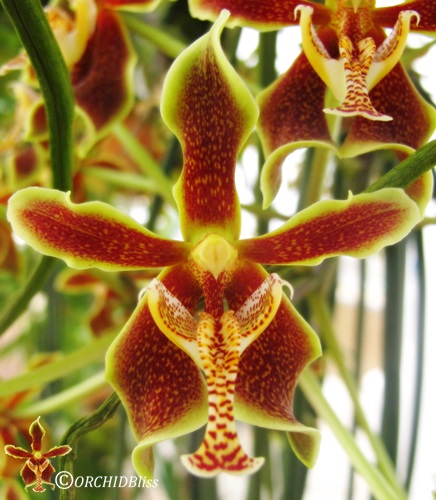
▼In case you wonder, how it looks like closeup. I use this picture for this blog's logo I changed the logo to another species - Phalaenopsis Violecea (locally called Lundu orchid - will talk about it in another post) as well as for watermark on pictures.
The flower measures between 4-6 cm across.
Paraphalaenopsis Labukensis closeup @ OrchidBliss

Our six plants went into flowering frenzy early of the year after resting for few years...can't remember how many years back. It was rainy season when they bloom - they love moisture.

▼Close up of Paraphalaenopsis labukensis's flower.
Paraphalaenopsis Labukensis blooming @ OrchidBliss

▼The leaves can grow up to 3 meters. Ours is about 1.5 meters in length. Some are longer.
Paraphalaenopsis Labukensis leaves @ OrchidBliss

▼Closeup of the flower and blooms.
Paraphalaenopsis Labukensis blooming @ OrchidBliss

▼This is how they look like from the bottom. Our Pps are planted in tilted perforated pots with charcoal to allow the leaves to hang down. 
Paraphalaenopsis Labukensis blooming clusters @ OrchidBliss

▼In a row.
Paraphalaenopsis Labukensis blooming clusters @ OrchidBliss

▼Wonder why this is of lighter color. Dear hubby (DH) also don't know why but they are the same species nevertheless.
Paraphalaenopsis Labukensis blooming @ OrchidBliss

The name labukensis is named after where this orchid can be found i.e. its origin.
If you google for Labuk, then you will be directed to Labuk, a place located in eastern Sabah.
If you are from Sabah, then you would know that this area has been subjected to various human activities, of which oil palm plantation development is the most threatening to this species and many other species endemic to the area.
Hopefully some conservation works in that area and nearby help to conserve and protect them before it is too late.

Pps. labukensis Care

  • Shade-loving and like good deal of moisture
  • Good ventilation and pot drainage
  • They can be grown logs, slabs and coconut husk
  • Shelter from rain and dripping water
  • Repotting - every 3 to 5 years